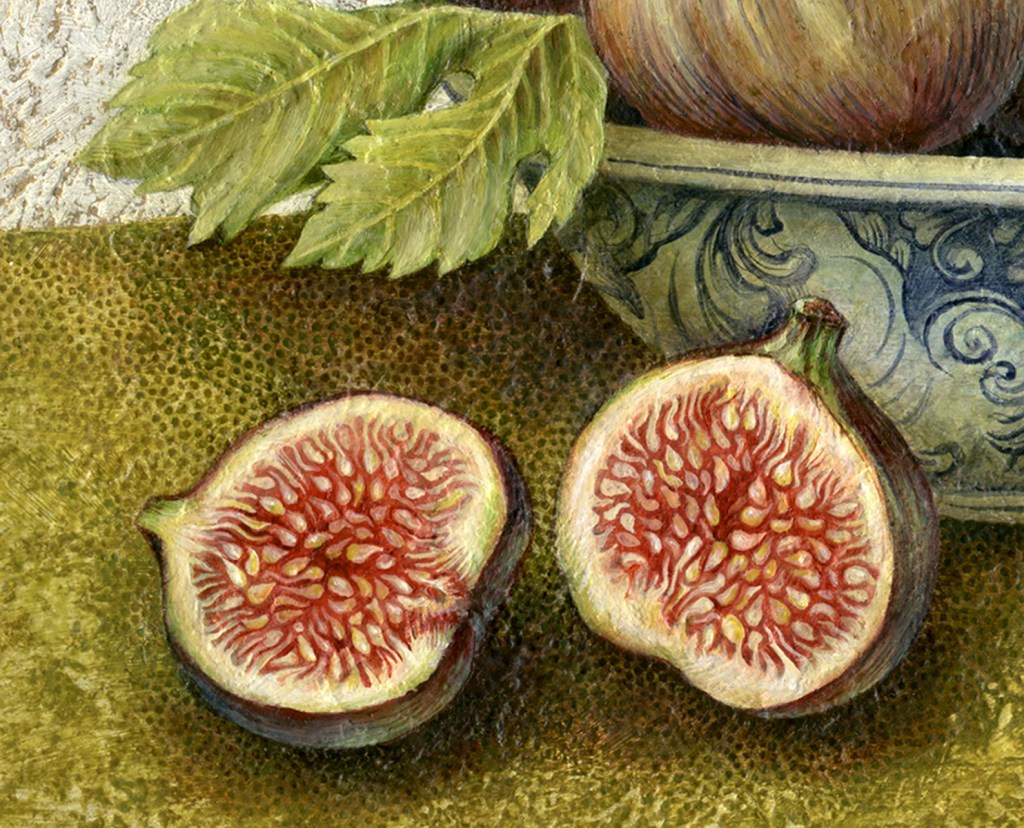
I currently have a fig plant with now two ripening fruits on the stem. The common fig, Ficus Carica, has been mentioned in many ancient texts. In Genesis 3, Adam and Eve used fig leaves to cover themselves after eating the forbidden fruit and realizing their nakedness. This tree of the heavens has also been a sacred symbol in Judaism, Ancient Egypt, Ancient Greek Mythology, and Roman Mythology. The deep purple, sweet, reversed flower found its significance in my life through a book.
The Bell Jar by Sylvia Plath (1932-1963) was published in 1963, just a few months before Plath’s tragic death. The Bell Jar is a semi-autobiographical novel and due to the noticeable events and characters within the novel Plath published under the pseudonym Victoria Lucas. Plath, notorious for the time, presents themes of mental health, feminism, and my Roman Empire, the fig tree analogy.
“I saw my life branching out before me like the green fig tree in the story. From the tip of every branch, like a fat purple fig, a wonderful future beckoned and winked. One fig was a husband and a happy home and children, and another fig was a famous poet and another fig was a brilliant professor, and another fig was Ee Gee, the amazing editor, and another fig was Europe and Africa and South America, and another fig was Constantin and Socrates and Attila and a pack of other lovers with queer names and offbeat professions, and another fig was an Olympic lady crew champion, and beyond and above these figs were many more figs I couldn’t quite make out. I saw myself sitting in the crotch of this fig tree, starving to death, just because I couldn’t make up my mind which of the figs I would choose. I wanted each and every one of them, but choosing one meant losing all the rest, and, as I sat there, unable to decide, the figs began to wrinkle and go black, and, one by one, they plopped to the ground at my feet.”
― Sylvia Plath, The Bell Jar
This small paragraph in her book made my soul ache. I reflected on all the lives I wanted, on the many versions of myself I could have become and still can involve into. I can picture myself in a walkable city or out in the country, or maybe a little house on the beach. I look back on past relationships and wonder what my life would be like if I lived in Colorado, North Carolina, or even Europe. Would I have been better suited for any of the various other professions I am interested in. What if I chose to have no children? Or many? My head spins with reflection, satisfactions, and regret. With so much potential, so many options with no guaranteed outcome; how is one to choose? Is watching your figs rot at your feet worse than picking the wrong one?
So, I inspect my fig tree, gently pinching the fruit to see if it has ripened yet. Admiring how quickly it has turned from green to purple in a few short days. I caress the leaves and thank the plant for its yield. I ponder over the fig’s significance and Sylvia Plath. I know when I first split the ripe fruit open between my teeth it will be a spiritual experience.
 Library of Vic
Leave a comment